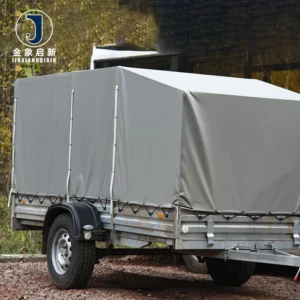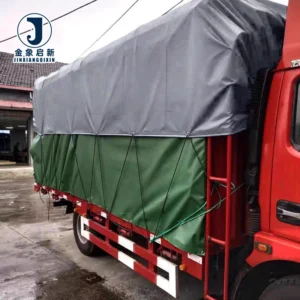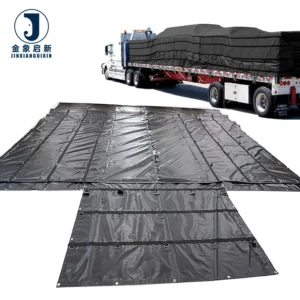
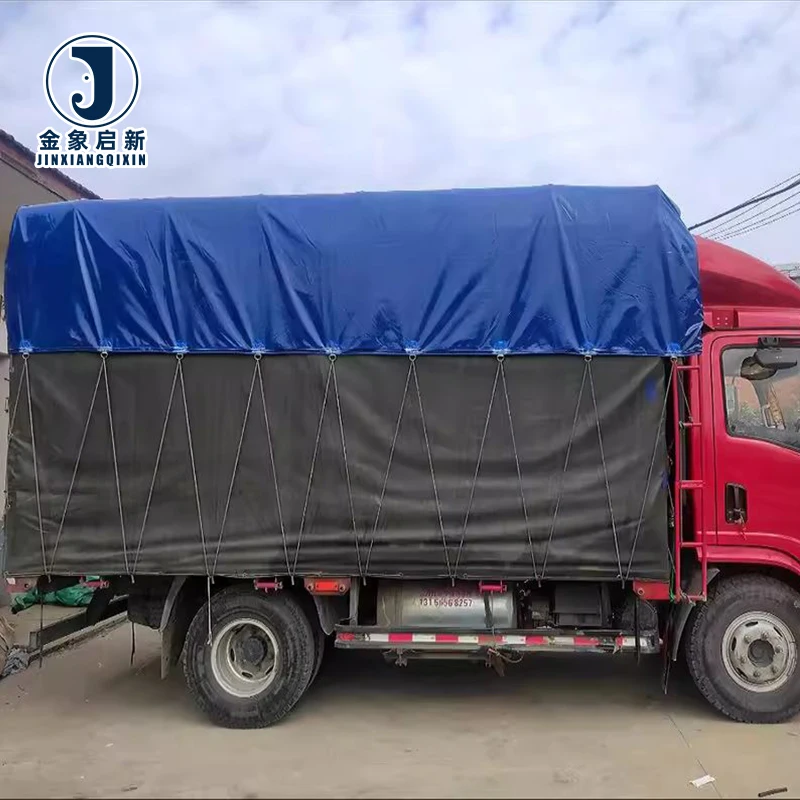
Precision Cut Fitment — covers developed against exact trailer dimensions, verified at every production stage with dedicated QA before dispatch.
Technical Specifications
| Parameter | Value |
|---|---|
| Product Type | PVC Truck Cover |
| Coating Material | PVC laminated sheet / vinyl canvas |
| Construction | Double-faced, uniform strength on both sides |
| Water Resistance | Water and mildew resistant |
| UV Protection | Anti-UV treatment available (test basis not stated in source — confirm grade required) |
| Flame Retardancy | Flame retardant treatment available (grade not stated in source — verify certification needed for your market) |
| Color Options | Multiple colors available |
Application Suitability
| Application | Exposure & Requirement |
|---|---|
| Side curtain for curtain-side trailers | Constant flexing at load points, road debris abrasion, sustained UV exposure during long-haul routes |
| Top roof cover for flatbed trailers | Full weather exposure, wind uplift on tie-downs, pooling water runoff |
| Pallet and load covers for logistics fleets | Frequent handling, stacking abrasion, yard weather exposure between dispatch cycles |
| Garage tent and carriage tent for transport depots | Semi-permanent outdoor siting, wind load on frame, UV and rain exposure across seasons |
| Outdoor event tent (block-out) and awnings | Crowd safety flame-retardant requirements, UV degradation from extended open-air use |
| Inflatable castle and water tank structures | Repeated inflation cycles, water contact, material flex and puncture risk |
Why a Generic-Size PVC Truck Tarpaulin for Trailer Fails at the Flex Points
Covers cut to standard dimensions leave loose fabric that billows, abrades and tears at the exact zones where the load shifts most.
Fleet operators ordering truck tarps off a size chart regularly discover that the hem line sits too high or the eyelets do not align with the trailer tie-down rails. The excess material flaps in road-speed wind, wearing through the coating at the weld seam within the first season. When the PVC truck tarpaulin for trailer use is instead cut to the specific vehicle model, every eyelet lines up with a rail anchor and the curtain drops cleanly to the deck, removing the loose fabric that causes early failure. [NEED_CITE: common failure modes in transport tarpaulin installations]
Curtain Drop and Eyelet Alignment for Curtain-Side Trailers
A side curtain must hang flat against the trailer body without wrinkling at the buckle straps or pulling away from the top rail. When the PVC truck tarpaulin for trailer curtain-side applications is cut to the exact door opening height and rail-to-deck measurement, the fabric tension distributes evenly across the full panel. This alignment keeps the weld seams from bearing concentrated load during cornering, which is where generic-size covers typically split first.
Top Roof Covers and Tie-Down Geometry
Flatbed top covers face a different stress pattern: wind uplift tries to lift the sheet while tie-down straps compress it against the load. The cover must be wide enough to drape past the load edge without pulling the eyelets out of the hem under strap tension. Getting this dimension right during the cutting stage prevents the strap-to-eyelet load path from over-stressing the reinforced edge during transit. [NEED_CITE: tie-down load distribution on flatbed tarpaulin systems]
Reading the Specification Sheet Beyond GSM
Double-faced PVC construction means the coating is applied to both sides of the base fabric, providing consistent mechanical properties regardless of which face contacts the load. This symmetry matters for side curtains that flex in both directions when the trailer corners. The water and mildew resistant surface prevents biological degradation when covers remain folded in damp conditions between trips. Anti-UV and flame retardant treatments are available as options, and you should confirm the specific grade and test standard required by your operating region before placing a production order — local fire codes and transport regulations vary significantly by market.
The Cost of Overlooking Weld Seam and Hem Reinforcement
A cover can have the correct coating weight and base fabric denier, yet fail early if the welded seams at high-flex zones are not matched to the material thickness. Hem folds that are too narrow leave insufficient material for the weld to grip, and the seam peels away under tie-down load before the fabric body shows any wear. Batch-to-batch color inconsistency across a fleet order also forces operators to reject entire shipments when two covers installed side by side on adjacent trailers show a visible shade difference. These are procurement failures that surface only after the covers are in service. [NEED_CITE: quality control standards for coated fabric welding]
Why Transport Equipment Builders Source This PVC Truck Cover Here
Full production lines dedicated to coated fabric mean the PVC truck cover runs through controlled coating, curing and finishing without queuing behind unrelated product categories. In-process QA checks at each stage catch thickness drift and color variation before the roll reaches the cutting table. The R&D team develops samples within days when a fleet operator needs a new trailer model dimension or a custom color matched to existing livery. Every shipment carries a pre-shipment inspection record that documents dimensions, eyelet count and weld seam quality against the original specification. Custom widths, colors and prints are produced on the same lines as standard stock, so volume and minimum requirements stay practical for fleet-scale orders.
Documentation & Verification
- Material specification sheet listing PVC coating type, base fabric construction and available color references
- Test report for UV and flame retardant grades where the buyer has specified a required standard
- Pre-shipment inspection record confirming cut dimensions match the nominated trailer model
- Roll packing list with individual roll identification for traceability
- Certificate of origin and customs documentation for international dispatch
Fabrication, Handling & Storage
- Heat-weld seams at temperatures matched to the double-faced PVC coating thickness to prevent delamination at flex zones
- Reinforce eyelet settings at high-load tie-down points using patch plates bonded to both PVC faces
- Store rolls horizontally on padded racks to prevent permanent creasing in the coated surface
- Unfold covers at ambient temperature to avoid coating stiffness cracking in cold conditions
- Clean with mild detergent only to preserve the anti-UV and flame retardant treatment integrity
- Allow full material relaxation before final trimming when cutting to specific trailer dimensions
What to Include in Your PVC Truck Cover Inquiry
Provide the trailer make, model and year along with measured body dimensions so the cover can be cut to exact fitment. Specify whether anti-UV or flame retardant treatment is required and which certification your operating region demands. Include the color reference from your fleet livery standard and confirm whether you need finished covers with eyelets and welded hems or roll stock for your own fabrication.
Frequently Asked Questions
Q: How do you cut truck covers to fit specific trailer models?
A: We take the exact body dimensions of the nominated trailer model — length, width, height and door opening geometry — and cut each PVC truck tarpaulin for trailer use to those measurements. Eyelet positions are set to match the trailer tie-down rails, and hem widths are calculated to provide enough material for a secure weld at the flex zones.
Q: What eyelet spacing and reinforcement options are available?
A: Eyelet spacing is set based on the tie-down rail configuration of your specific trailer model. Reinforcement at each eyelet uses patch plates bonded to the double-faced PVC surface to distribute tie-down load across a wider area, reducing the risk of pull-through under sustained road vibration and wind uplift.
Q: How is anti-UV performance verified for long-haul exposure?
A: Anti-UV treatment is available as an option on this PVC truck cover range. The specific test standard and grade should be confirmed against the UV exposure conditions of your transport routes and the compliance requirements of your market. We supply the applicable test report when a grade is specified at order stage.
Q: What flame-retardant grades are available and which certifications do they meet?
A: Flame retardant treatment is offered in grades that can be matched to different market requirements. The specific grade and corresponding certification must be confirmed before production, as fire safety regulations for transport covers and temporary structures vary by region. Request the grade that your job site or operating authority requires.
Q: How do you prevent welded seam failure at high-flex points on side curtains?
A: Weld parameters are set to match the PVC coating weight and the double-faced construction of the fabric. At high-flex zones such as curtain edges and buckle strap positions, we increase hem width and add reinforcement patches so the weld bond area carries the cyclic load without peeling. Every seam is inspected before shipment.