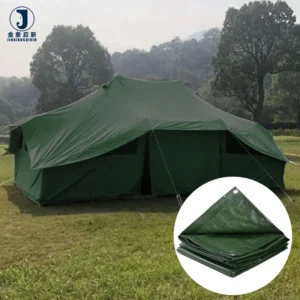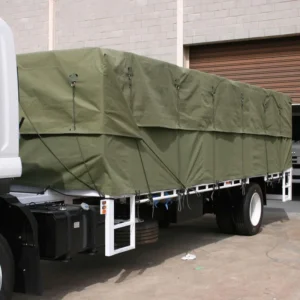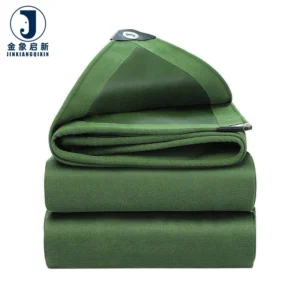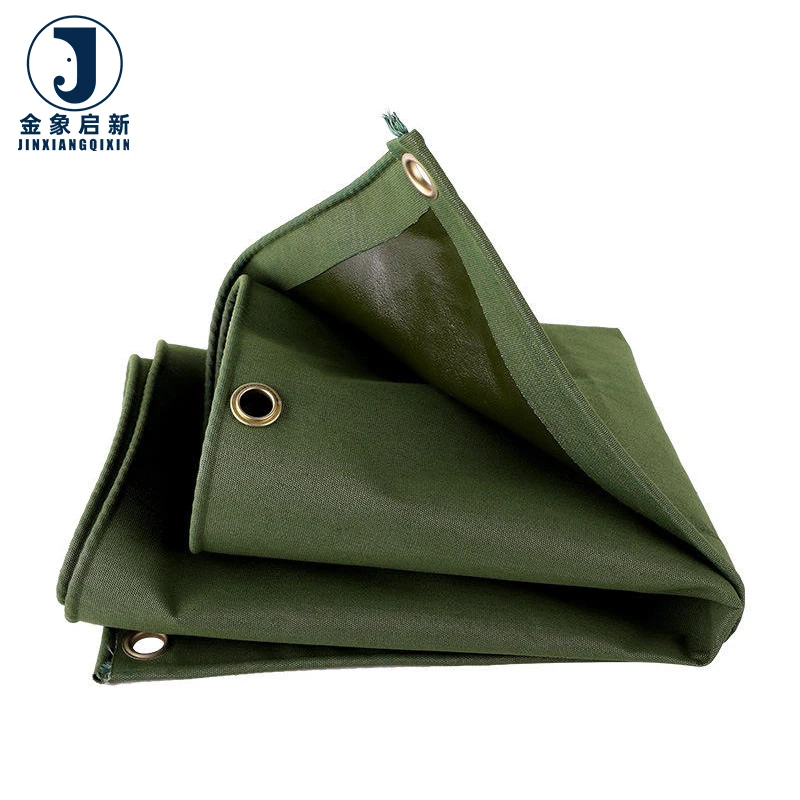
Purpose-Built Coating Control — Our 600gsm PVC laminated canvas tarpaulin undergoes coating weight verification at every production stage, ensuring the GSM you order is the GSM that arrives on your loading dock.
Technical Specifications
| Parameter | Value |
|---|---|
| Product Type | PVC Coated Tarpaulin |
| Base Fabric | Polyester cotton industrial textile with 8–12 strands of fine cotton yarn |
| Weight | 600gsm |
| Coating Method | Laminated |
| Thickness | 0.5mm / 0.6mm / 0.7mm (grade not stated in source) |
| Roll Width | 2m |
| Roll Length | 100m |
| Color | Army Green Camouflage / Custom |
| UV Treatment | UV resistant (test basis not stated in source) |
| Flame Retardant Grade | Not stated in source |
| Anti-Static | Not stated in source |
| Waterproof Rating | Waterproof (no hydrostatic head value provided) |
| Edge & Hem Reinforcement | Rust-proof aluminum eyelets every 1 meter at corners and hem; folded and welded seams sewn with poly ropes |
| Finish Product Size | Custom as per customer’s needs or sold by inventory |
| Standards | CE, ISO (specific standard numbers not stated in source) |
Application Suitability
| Application | Exposure & Requirement |
|---|---|
| Truck canopy and trailer side curtain | Constant flexing at load points, road abrasion, highway wind loads, repeated tie-down stress |
| Open-air flatbed cargo cover | Direct weather exposure, UV radiation, water ingress prevention during long-haul transit |
| Transport fleet load covering | Daily deployment and removal, friction against cargo edges, tie-down strap pressure |
| Construction site equipment cover | Dust, debris impact, prolonged outdoor storage, ground moisture contact |
| Outdoor awning and tent fabric | Sustained tension, wind uplift, solar exposure, seasonal installation cycles |
Why Seams Fail Before the Fabric Does on Moving Loads
Reinforcement at the flex zone is where a truck cover survives or fails.
When a PVC laminated canvas tarpaulin for truck cover applications is strapped over a shifting load, the highest stress concentrates not on the field of the fabric but at the hem and eyelet line. Every braking event, every corner taken at speed, transfers kinetic energy through the tie-down straps into the grommets and the seam that holds them. If the hem is simply folded and heat-welded without mechanical reinforcement, the weld line cracks under cyclic loading long before the 600gsm fabric itself reaches its tear limit [NEED_CITE: tensile and tear test methods for coated fabrics per ISO 1421]. The result is a cover that looks intact in the center but is pulling apart at the edges — and cargo is exposed.
Hem Construction That Matches Road Dynamics
The PVC laminated canvas tarpaulin for truck cover use is built with rust-proof aluminum eyelets placed every 1 meter along the corners and hem line. This interval spacing distributes tie-down load across multiple anchor points rather than concentrating force on a few widely spaced grommets. Each eyelet sits within a folded hem that is both welded and sewn around a poly rope core, creating a mechanical lock that resists the peel forces generated when straps pull at an angle during transit.
Covering the Moving Load Without Generic Sizing
Fleet operators know that a truck cover cut to a generic rectangle will billow, chafe, and leave corners exposed. This PVC laminated canvas tarpaulin supports custom cut-to-model sizing so the cover is shaped to the specific trailer dimensions — including wheel arch cutouts, tailgate clearance, and roof bow profiles. A fitted cover sits tighter in crosswinds, reduces fabric flutter fatigue, and eliminates the excess material that catches on loading dock edges [NEED_CITE: DIN standard test methods for coated fabric flexibility and fatigue].
Reading the Specification Sheet Beyond GSM
The 600gsm weight of this PVC laminated canvas tarpaulin reflects the combined mass of the polyester-cotton base fabric and the laminated PVC coating, but weight alone does not define how the material behaves under load. The 8–12 strand fine cotton yarn construction within the base textile determines the weave density, which governs tear propagation resistance — a tightly woven base stops a puncture from becoming a split. The laminated coating method bonds the PVC film to the textile under heat and pressure, producing a smooth, waterproof surface that sheds water quickly and resists dirt adhesion during long-haul exposure. The available thickness options of 0.5mm, 0.6mm, and 0.7mm allow specifiers to balance flexibility for daily folding against rigidity for standing seam applications. Roll stock at 2m width by 100m length suits fabrication shops cutting custom panels with minimal cross-direction joins.
The Cost of Overlooking Edge Detail in Fleet Specifications
Buyers who focus exclusively on per-square-meter pricing often discover the true cost when a batch of truck covers fails at the hem within the first season. Cyclic wind loading on a poorly reinforced eyelet line causes the grommet to tear through the fabric, leaving the cover flapping open on the highway [NEED_CITE: field failure analysis of tarpaulin hem and eyelet systems]. Equally, a laminated fabric specified without confirming UV treatment documentation may show surface chalking and loss of flexibility after months of direct sun exposure, making the material brittle and prone to cracking at fold lines. These failures do not appear in a warehouse inspection — they emerge only after weeks of road use, by which time the supplier’s leverage is gone.
Why Transport Specifiers Source This PVC Laminated Canvas Tarpaulin Here
Nearly 30 years of continuous coated fabric production gives our process control a depth that shows in roll-to-roll consistency — the 600gsm weight you verify on the first roll holds across the entire order. Three full production lines and 36 sets of professional equipment support bulk fleet orders without splitting production across incompatible machines. A 10-person R&D team handles cut-to-model pattern development, ensuring each truck and trailer variant in your fleet receives a cover shaped to its actual body dimensions. Dedicated QA/QC at every stage includes pre-shipment weight and dimension checks, so GSM deviations are caught before dispatch rather than on your receiving dock. Custom samples are developed within days, allowing your procurement team to validate fit and finish before committing to full production.
Documentation & Verification
- Material specification sheet confirming base fabric denier, coating method, and 600gsm weight for each roll
- Pre-shipment inspection record verifying GSM matches the quoted specification before dispatch
- CE and ISO certification documentation included with every shipment
- Roll packing list with individual roll identifiers for traceability across your fleet
- Certificate of origin and customs documentation prepared for cross-border delivery
Fabrication, Handling & Storage
- Weld temperature must suit laminated PVC construction to avoid delamination at seam joints
- Aluminum eyelets every 1 meter require backing plates at high-tension tie-down zones
- Store 2m rolls upright on pallets to prevent permanent creasing of the 600gsm canvas
- Poly-rope sewn hems should not be dragged across abrasive surfaces during installation
- Clean laminated PVC surface with mild detergent — solvent-based cleaners may attack the coating bond
What We Need to Quote Your Fleet Order
Provide the truck and trailer model list, including body dimensions and roof bow spacing, so we can confirm cut-to-model panel sizing. Specify the eyelet spacing and hem reinforcement level your tie-down system demands, and confirm whether you require UV or flame retardant treatment documentation for your operating region. Let us know if you need finished covers with welded seams and installed grommets, or roll stock for your own fabrication line.
Frequently Asked Questions
Q: How is the 600gsm weight verified before the PVC laminated canvas tarpaulin reaches us?
A: Every roll undergoes a pre-shipment weight inspection against the stated 600gsm specification. The inspection record is included with your dispatch documentation, showing the measured GSM for each roll so you can confirm the material matches the quotation without conducting your own destructive testing on arrival.
Q: Can truck covers be cut to fit specific trailer models rather than generic sizes?
A: Yes. We develop cut-to-model patterns based on your trailer body dimensions, including wheel arch profiles, tailgate clearance, and roof bow spacing. A sample cover is produced for fit validation before bulk production begins, ensuring each vehicle in your fleet receives a cover shaped to its actual geometry.
Q: What eyelet spacing and hem reinforcement options are available for high-wind transit routes?
A: Standard configuration includes rust-proof aluminum eyelets every 1 meter along corners and hem, with poly-rope sewn reinforcement. For high-wind corridors, we can adjust eyelet interval density and add backing plates. Share your route conditions and tie-down hardware specifications so we can recommend the appropriate configuration.
Q: How is colour consistency maintained across multiple rolls for a uniform fleet appearance?
A: All rolls for a single fleet order are produced within the same coating batch using matched pigment formulation. The 10-person R&D team monitors colour consistency across the production run. We recommend requesting a pre-production sample to confirm shade approval before full-order manufacturing begins.
Q: What UV treatment documentation supports the outdoor weather resistance claim?
A: UV resistance is stated for this material, and the specific test basis can be confirmed for your market’s requirements. Request the UV test report during the inquiry stage so you can verify the treatment level matches the exposure conditions your fleet encounters on long-haul routes.