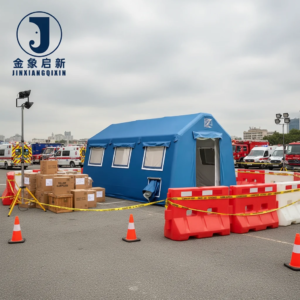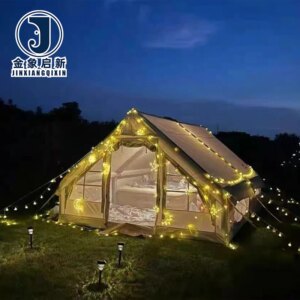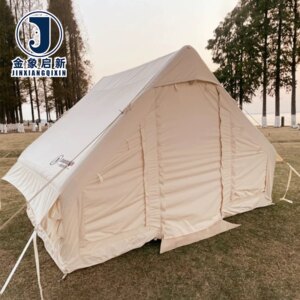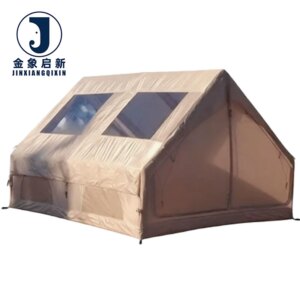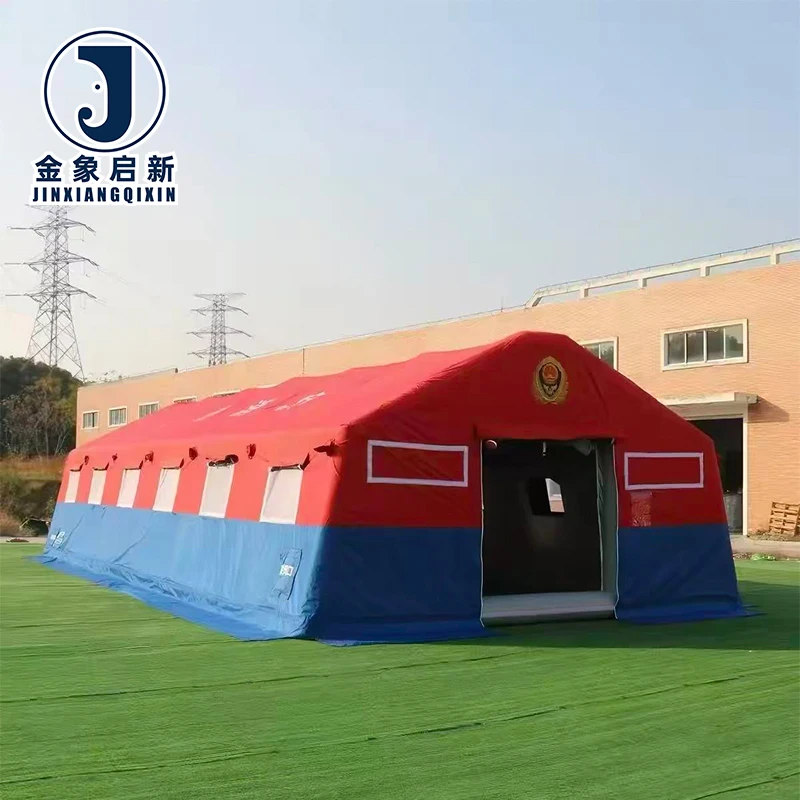
Rapid Custom Sizing — inflatable PVC camping tents cut and welded to your exact footprint, not a generic consumer-grade shelter that fails when operations scale up.
Technical Specifications
| Parameter | Value |
|---|---|
| Product Type | PVC Tent |
| Core Material | PVC tarpaulin |
| Waterproof Rating | 3000mm |
| Structure | Single Layer Construction |
| Design Type | Four-Season Design |
| Deployment | Quick Automatic Opening |
| Customization | OEM & ODM (sample customization, pattern printing) |
| Certifications | ISO9001, ISO14001, ISO45001, CE |
Application Suitability
| Application | Exposure & Requirement |
|---|---|
| Temporary site offices at construction projects | Continuous weather exposure, daily foot traffic, wind loading on inflated frame |
| Equipment storage shelters for transport fleets | Moisture ingress prevention, UV exposure over extended parking periods, forklift proximity |
| Mobile field stations for environmental monitoring | Rapid deployment in remote locations, temperature swings across seasons, dust and debris |
| Temporary warehousing for logistics operations | High-volume loading clearance, sustained inflation pressure, abrasion from cargo handling |
| Disaster relief shelter | Emergency deployment under adverse conditions, ground moisture, multi-family occupancy stress |
Why Spec Sheet Waterproof Claims Fail When the Storm Arrives
A 3000mm waterproof rating only matters if the seams and welds hold at the same threshold as the fabric itself.
Every procurement team has received an inflatable PVC camping tent with a certificate stating one rating, only to find water penetrating at welded joints during the first heavy rain. The base fabric may resist hydrostatic pressure, but inflation seams carry concentrated stress that generic welding parameters cannot sustain. Field failures cluster around door zips, valve penetration points, and tube-to-canopy junctions [NEED_CITE: hydrostatic pressure testing methods for coated fabrics per ISO 1421]. Inflatable PVC Tent for truck and transport applications demands verification that the entire assembled unit, not just the roll stock, passes waterproof validation before dispatch.
Sizing That Matches Your Fleet Layout, Not a Catalog Page
Transport fleet operators know the cost of a shelter that is two meters too short for the maintenance bay. Our Inflatable PVC Tent for truck and transport operations ships in OEM dimensions developed from your specific site drawing, with door placement and inflation valve routing adjusted to your workflow. The single layer construction keeps packed volume manageable for container loading across multiple units while maintaining the four-season design integrity your operations require year-round.
Deployment Speed That Compresses Project Timelines
When a disaster relief convoy arrives or a construction site needs immediate weather cover, hours spent assembling pole frames translate directly into lost productivity. The quick automatic opening mechanism on this inflatable PVC camping tent reduces setup to an inflation cycle, allowing site crews to redirect labor to critical-path tasks. Each unit ships with matched inflation hardware, and the PVC tarpaulin body retains flexibility across the temperature range that four-season conditions impose [NEED_CITE: low-temperature flexibility testing for PVC coated fabrics].
Reading the Material Specification Beyond the Waterproof Number
A 3000mm waterproof rating describes the hydrostatic head the PVC tarpaulin can sustain before moisture penetrates the coating layer. This value depends on coating thickness, plasticizer formulation, and base fabric weave density working together. The single layer construction approach used here prioritizes transportation efficiency — each packed unit occupies less container space, which matters when disaster relief procurement involves shipping hundreds of shelters. The four-season design requires the PVC compound to remain pliable in cold conditions without softening excessively under direct summer sun, a balance controlled through plasticizer selection and coating weight [NEED_CITE: tensile and tear test methods for coated fabrics per ISO 1421]. Quick automatic opening relies on the tube structure maintaining consistent internal pressure, which depends on weld seam integrity at every tube junction.
What Happens When Inflatable Tent Specifications Are Misread
Procurement teams sometimes assume a higher waterproof rating automatically covers all failure modes, then discover that wind-driven rain enters through inadequately sealed valve penetrations. Others order multiple units without verifying batch-to-batch colour consistency, resulting in a disaster relief camp where adjacent shelters show visible shade differences under sunlight. Welded seams on inflatable structures carry cyclic pressure loads every time the frame is inflated and deflated, and generic welding temperatures that work for flat tarpaulins produce brittle joints on curved tube intersections [NEED_CITE: weld strength testing standards for inflatable coated fabric structures]. These failures surface after deployment, when replacement logistics cost far more than the original order.
Why This Source Supports Your Inflatable Shelter Procurement
Production runs on three dedicated lines with 36 sets of processing equipment allow parallel manufacturing of custom-sized inflatable PVC camping tents without one order delaying another. The 10-person R&D team develops inflation tube patterns and valve configurations matched to your deployment scenario, producing sample units for field validation before bulk production proceeds. Every tent undergoes 100% pre-shipment inspection covering seam integrity, inflation pressure retention, and dimensional verification against the approved drawing. ISO9001 and ISO14001 systems govern process consistency, while CE certification supports market access documentation for destination countries. Custom pattern printing integrates directly into the production flow, avoiding the secondary handling that damages finished surfaces.
Documentation & Verification
- Waterproof test report specifying 3000mm rating achieved on assembled inflatable PVC camping tent unit
- Material specification sheet stating PVC tarpaulin grade, coating weight, and base fabric construction
- CE certificate confirming compliance for destination market import requirements
- Pre-shipment inspection record documenting dimensional check and inflation test for each unit
- ISO9001 and ISO14001 compliance certificates covering manufacturing process control
Fabrication, Handling & Storage
- Welded seams on single layer PVC tarpaulin require matched heat settings at curved tube junctions to prevent brittle failure under inflation pressure
- Deflated units should be rolled rather than folded to avoid permanent crease marks on the PVC tarpaulin coating surface
- Store packed inflatable PVC camping tents above ground level in ventilated conditions to prevent moisture trapping against the coating
- Clean PVC tarpaulin surfaces with neutral pH detergent only; solvent-based cleaners degrade plasticizer content
- Repair minor punctures using PVC-compatible adhesive patches applied to fully deflated and dry tube sections
- Verify quick automatic opening valve threads match your inflation pump connector before field deployment
Before You Submit an Inquiry
Provide your intended application scenario and the environmental conditions the inflatable PVC camping tent will face, including typical wind exposure and temperature range. Specify the internal floor dimensions required and whether multiple units need to interconnect. Confirm any fire-retardant or compliance requirements your destination market mandates. If OEM pattern printing or branding is needed, share artwork files for sample development.
Frequently Asked Questions
Q: How is the 3000mm waterproof rating tested and verified before shipment?
A: Each inflatable PVC camping tent undergoes hydrostatic pressure testing on the assembled unit, not just the base PVC tarpaulin roll. Test results are documented in a report that accompanies your shipment, covering both the fabric body and the welded seams at tube junctions where failures most commonly occur during field deployment.
Q: What OEM sizing and customization options are available for specific operational needs?
A: The 10-person R&D team develops inflatable PVC tent dimensions, door placements, and valve configurations from your site drawings. Sample units are produced for approval before mass production, and pattern printing can be integrated directly into the PVC tarpaulin coating process to match your branding requirements.
Q: How does the quick automatic opening mechanism perform under adverse weather conditions?
A: The inflation system is designed for four-season deployment, with PVC tarpaulin tube structures that retain flexibility in cold temperatures. Single layer construction keeps the overall packed weight manageable, allowing rapid setup even when ground conditions are wet or uneven at disaster relief staging areas.
Q: What documentation accompanies each batch to support compliance and traceability?
A: Every shipment includes a waterproof test report, material specification sheet, CE certificate, and pre-shipment inspection record. ISO9001 and ISO14001 certificates are available to support your import documentation requirements and to verify that the inflatable PVC camping tent was manufactured under controlled process conditions.
Q: How are bulk orders packed and transported to prevent damage during logistics?
A: Units are rolled rather than folded to protect the PVC tarpaulin coating from permanent crease damage. Each inflatable PVC camping tent is individually wrapped and loaded with spacing to prevent compression marks, with container loading plans optimized for your order volume and destination port requirements.