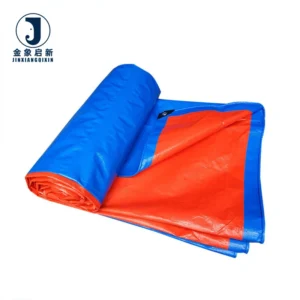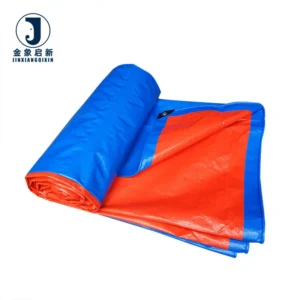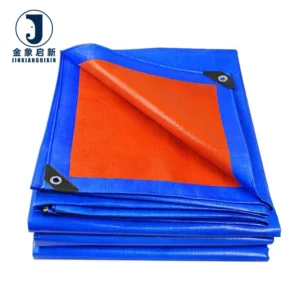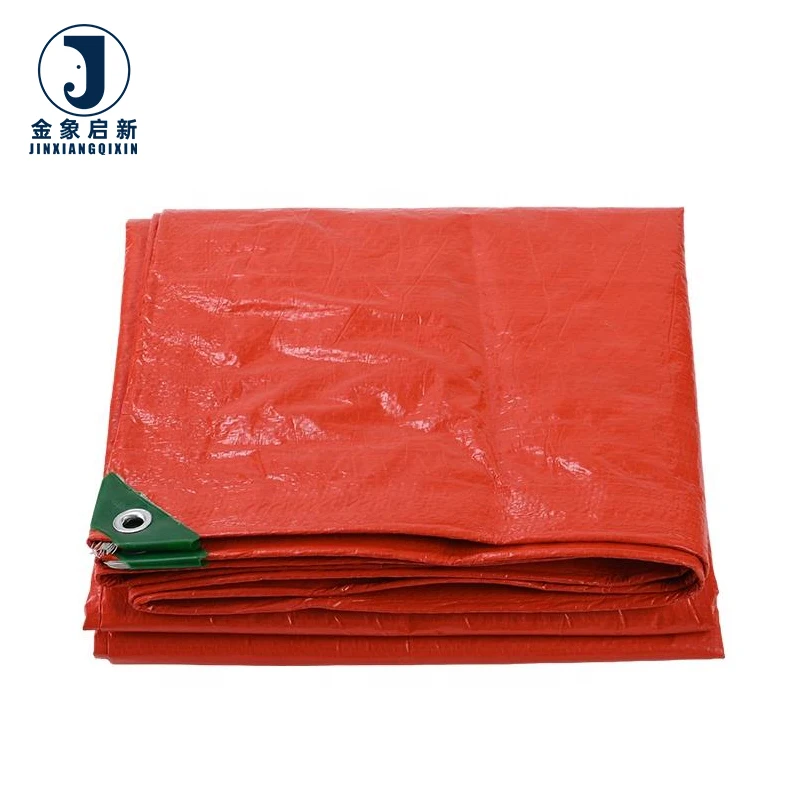
Proven coating control — Nearly three decades of PE tarpaulin production experience ensures every truck and trailer cover meets its stated weight and reinforcement requirements before dispatch.
Technical Specifications
| Parameter | Value |
|---|---|
| Product Type | PE Tarpaulin |
| Material | Polyethylene (PE) |
| Weight (GSM) | 40g~500g/m² (confirm specific grade for your application) |
| Thickness | 0.18–0.35 mm |
| Mesh Count | 8×8 / 10×10 / 12×12 |
| Tensile Strength (N/5cm) | Meridian 300–1200 / Latitude 250–1000 (varies by grade) |
| Waterproof Surfaces | Double-sided waterproof |
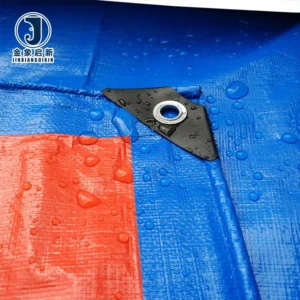
| Corner Reinforcement | Reinforced corners |
| Eyelet Spacing (Center to Center) | 39.4 Inches |
| UV Treatment | UV treatment is available (test basis not stated in source) |
| Flame Retardant Grade | Available in flame retardant grades — confirm the grade required for your market |
| Size | Custom size |
| Color | Custom color |
| Certifications | ISO 14001, ISO 45001, CE |
Application Suitability
| Application | Exposure & Requirement |
|---|---|
| Long-haul truck and trailer load covering | Constant road vibration, wind flapping at high speeds, UV and weather exposure, tie-down load stress at eyelets and hems |
| Side curtain fabric for new trailer builds | Repeated flexing at load points, abrasion against trailer frame, consistent batch colour across multiple units |
| Fleet replacement covers for specific trailer models | Precise fitment to avoid loose fabric, reinforced hems to resist tearing during daily tensioning |
| Agricultural and warehouse stockpile covers | Outdoor weathering, UV exposure, protection from moisture ingress, lightweight handling |
Why a Generic-Size PE Tarpaulin Fails Your Truck and Trailer Fleet
A cover that is not cut to your exact trailer model will flap, abrade, and tear at the seams within months of highway use.
Fleet operators frequently receive truck covers that are slightly off-dimension, leading to fabric bunching or excessive tension. This mismatch concentrates stress at the welded seams and eyelet holes, exactly where the load flexes most during transit. The result is premature failure, exposed cargo, and the cost of mid-route replacements. Sourcing a PE tarpaulin for truck and trailer cover applications requires model-specific sizing to eliminate these failure points [NEED_CITE: tensile and tear test methods for coated fabrics per ISO 1421].
Model-Specific Fitment Eliminates Transit Damage
When a PE tarpaulin for truck and trailer cover use is cut to the precise dimensions of your vehicle, the fabric sits flat under tension. Flat fabric resists wind catch, reducing the flapping that fatigues welded seams over thousands of kilometres. Our production team works from your trailer model drawings to set cut sizes, ensuring the cover reaches every corner and ties down without excess material dragging on the road.
Reinforced Corners and Eyelets Carry the Tie-Down Load
The connection points between a cover and its trailer bear the highest mechanical stress. Reinforced corners and double waterproof surfaces concentrate material strength where ropes and straps pull. The 39.4-inch center-to-center eyelet spacing distributes load evenly along the hem, preventing individual eyelets from pulling through under tension. This configuration suits standard tie-down systems used across regional and long-haul transport fleets [NEED_CITE: DIN standard for tie-down load testing on tarpaulins].
Weight and Weave Grades Matched to Transport Intensity
Lightweight grades with an 8×8 mesh count serve short-haul or static storage roles, while heavy-duty options with a 12×12 weave withstand continuous highway exposure and heavy tie-down loads. Selecting the correct GSM and weave density prevents both under-specification, which leads to early tearing, and over-specification, which adds unnecessary weight and handling difficulty. The tensile strength range from meridian 300 to 1200 N/5cm reflects this grade spectrum.
Reading the Specification Sheet Beyond GSM
GSM alone does not predict how a PE tarpaulin will perform on a moving trailer. The base fabric mesh count — whether 8×8, 10×10, or 12×12 — determines how load distributes across the weave before the coating carries any stress. A higher mesh count with the same GSM means finer yarns and potentially lower tear resistance; a coarser mesh with the same weight uses thicker yarns that resist tear propagation. Thickness, ranging from 0.18 to 0.35 mm, correlates with abrasion resistance against trailer frames and tie-down hardware. Coating adhesion, which is not stated in GSM, governs whether the PE layer delaminates at flex points before the base fabric itself fails. Buyers should request the base fabric denier alongside the GSM to evaluate the full performance picture.
The Hidden Cost of Batch Colour Variation
When a fleet operator orders multiple PE tarpaulin covers for identical trailers, colour variation between rolls becomes visible the moment they are installed side by side. This inconsistency signals uneven coating dispersion, which can also mean variable UV treatment distribution and differing tensile properties across the batch. Beyond aesthetics, a cover that fades faster than its neighbour indicates a coating formulation that may not withstand the same road exposure duration [NEED_CITE: UV degradation testing standards for polyethylene coatings].
Why Source Your PE Tarpaulin Through This Channel
Three full production lines with 36 sets of professional equipment provide the capacity to fulfil fleet-scale orders with consistent on-time delivery. A dedicated 10-person R&D team handles model-specific pattern cutting, custom sizing, and sample development within days, not weeks. In-process quality checks at every production stage, backed by 100% pre-shipment inspection, ensure that every roll and cut piece meets the stated specification before it leaves the facility. Material specification sheets, test reports for UV treatment, and pre-shipment inspection records accompany every dispatch, giving buyers documentary proof of what they ordered. ISO and CE certifications support compliance documentation for markets that require it.
Documentation & Verification
- Material specification sheet confirming GSM, base fabric mesh count, and PE coating weight for the ordered grade
- Pre-shipment inspection record verifying eyelet spacing, hem reinforcement, and cut dimensions against your trailer model
- UV treatment test report provided when UV resistance is specified for your application
- Roll packing list detailing piece count, weight, and dimensions for customs clearance
- ISO 14001 and CE certificates supporting your market compliance requirements
- Certificate of origin for import documentation
Fabrication, Handling & Storage
- Heat welding parameters vary by PE coating thickness — confirm temperature and dwell time for the 0.18–0.35 mm range before production
- Reinforced corners and hem folds must align with tie-down hardware spacing to distribute load correctly
- Store rolls vertically in a dry environment to prevent permanent creasing that weakens the PE coating at fold lines
- Unfold covers at ambient temperature to avoid stressing the PE layer, which becomes brittle in cold conditions
- Clean with mild detergent and water to protect the double waterproof surface treatment from solvent damage
Request a Quotation for Your Fleet
To receive an accurate specification and sample for your PE tarpaulin truck and trailer covers, provide your trailer model dimensions, the tie-down system you use, and the expected route conditions. Indicate whether UV treatment or a specific flame retardant grade is required for your operating market. Confirm whether you need finished cut-to-size covers or roll stock for in-house fabrication, along with your annual volume requirement.
Frequently Asked Questions
Q: How do I provide my trailer model dimensions for a precise fit?
A: Send the manufacturer, model designation, and year of your trailer, along with any drawings or dimension sheets from the trailer builder. Our team uses these to set cut sizes and eyelet placement, then produces a sample for your approval before bulk production begins.
Q: What eyelet spacing and hem reinforcement options are available for tie-down loads?
A: Standard eyelet spacing is 39.4 inches center-to-center, with reinforced corners at high-stress points. Custom spacing and additional reinforcement patches can be specified to match your tie-down hardware layout and the load tension your fleet encounters on route.
Q: How is GSM verified on arrival to match the quotation?
A: Each roll and cut piece is weighed and measured during pre-shipment inspection. The inspection record confirms the actual GSM against the quoted value, and this document accompanies your shipment so you can cross-check upon receipt.
Q: Do you supply roll stock or only cut-to-size sheets?
A: Both options are available. Roll stock suits buyers with in-house fabrication capability, while cut-to-size covers are produced to your specific trailer model dimensions with finished hems and eyelets installed at the factory.