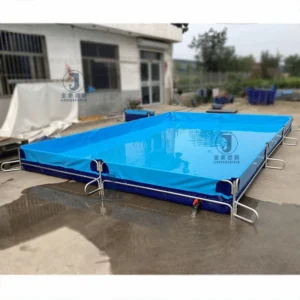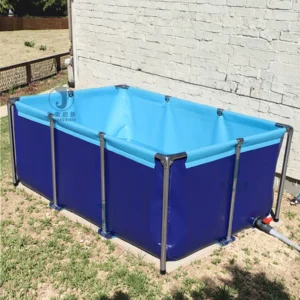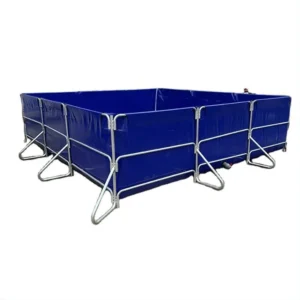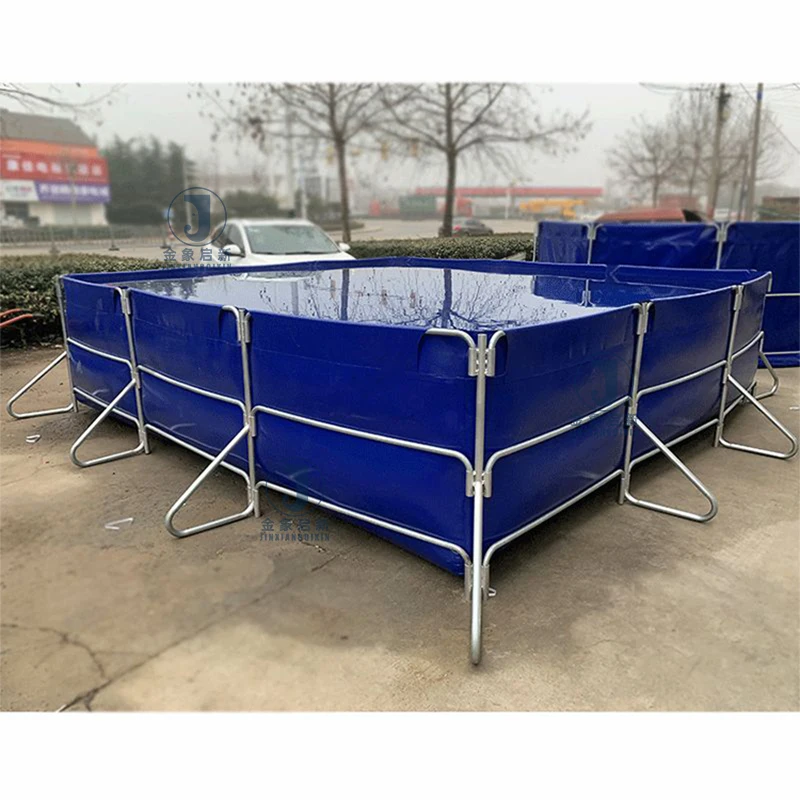
Consistent Coating Weight — Every roll undergoes pre-shipment verification to ensure the PVC coating GSM matches your purchase order specification exactly, eliminating the common shortfall seen on arrival.
Technical Specifications
| Parameter | Value |
|---|---|
| Product Type | PVC Tarpaulin Fish Pond Liner |
| Material | PVC & Polyester |
| Yarn Count Options | 500D-500D / 500D840D / 500D1000D / 1000D1000D / 1000D1300D / 1300D1300D / 1000D2000D |
| GSM Options | 350 / 400 / 420 / 500 / 600 / 650 / 750 / 900 |
| Total Thickness Options | 0.29mm / 0.32mm / 0.38mm / 0.44mm / 0.46mm / 0.55mm / 0.65mm |
| Mesh Density Options | 3019 / 2020 / 30*15 |
| Tensile Strength – Warp | 1650N – 3900N (varies by grade, test basis not stated) |
| Tensile Strength – Weft | 1600N – 3500N (varies by grade, test basis not stated) |
| Key Features | Water Resistant, Waterproof, Flame Retardant (grade not stated), Anti-UV (test basis not stated) |
| Shape Options | Foldable, Circular, Rectangular |
| Certifications | ISO, CE |
Application Suitability
| Application | Exposure & Requirement |
|---|---|
| Commercial fish ponds | Permanent water contact, soil chemistry exposure, puncture risk from substrate |
| Transport holding tanks on trucks | Dynamic flexing during transit, water weight load, UV exposure during loading |
| Aquaculture hatcheries | Biosecurity containment, frequent drain-and-refill cycles, chemical treatment contact |
| Agricultural reservoir lining | Extended sun exposure, livestock access abrasion, seasonal temperature fluctuation |
Why Stated GSM Does Not Guarantee Pond Liner Durability
Coating weight verification before dispatch is the only reliable safeguard against receiving material lighter than quoted.
Buyers sourcing a PVC Tarpaulin Fish Pond Liner for aquaculture operations regularly encounter a familiar problem: the GSM written on the commercial invoice does not match the material that arrives on-site. A liner specified at 650 GSM may weigh noticeably less per square metre once unrolled, reducing puncture resistance and tensile capacity at the exact moments a filled pond depends on structural integrity. When pond depth and stock density are calculated on a weight grade that was never actually delivered, seam stress and substrate abrasion failures follow predictably. [NEED_CITE:]
Covering a Moving Load During Fish Transport
Fleet operators who transport live fish stock between hatchery and grow-out sites place unusual demands on containment fabric. A PVC Tarpaulin Fish Pond Liner used inside a truck bed or trailer must hold several tonnes of water while the vehicle negotiates corners, braking forces, and uneven road surfaces. The fabric flexes continuously at the sidewall-to-base junction, and any weakness in the weld line or coating adhesion will surface quickly under that cyclic loading. Selecting the correct yarn count and GSM grade for the expected water volume is the difference between a liner that survives hundreds of trips and one that requires patching after the first season.
Weld Seam Behaviour at Flex Points in Filled Ponds
When a rectangular or circular pond is filled to capacity, the greatest mechanical stress concentrates where the floor panel meets the sidewall. Hot-air welded seams in PVC coated fabric rely on coating-to-coating fusion, and the quality of that bond depends directly on coating weight and formulation consistency. If the coating is lighter than specified, the weld interface has less material to fuse, and the seam can peel or delaminate while the fabric body remains intact. Operators who have seen weld failures before fabric failures in the field will recognise this pattern. [NEED_CITE:]
How Denier, Density, and GSM Interact in Pond Liner Performance
Base fabric denier and mesh density work together with coating weight to determine how a pond liner handles puncture and tensile load. A 1000D1000D yarn at 2020 density provides a tighter, heavier base that resists tear propagation when a sharp object contacts the liner floor — but the GSM only reflects the total combined weight of base fabric plus coating on both sides. Two liners rated at the same GSM can have very different base fabric proportions: one may carry a thick coating on a light base, while the other distributes weight more evenly across a heavier weave. For pond applications where substrate abrasion is the primary threat, the denier and density combination matters as much as the headline weight. Coating method also influences performance — knife-over-roll coating typically produces a thicker, more uniform PVC layer suited to pond liner demands, while calendering can yield a thinner, more economical finish better suited to lighter-duty covers.
The Hidden Cost of Receiving the Wrong Colour Batch
Aquaculture operators installing multiple pond liners across a single farm site expect visual consistency from roll to roll. When colour varies between batches — particularly on liners that sit side by side in a visible installation — the result is a patchwork appearance that signals poor sourcing to visiting clients and auditors. The underlying issue often traces to pigment dosing variation between production runs that were not managed under a single dye-lot allocation. Beyond aesthetics, inconsistent colour can indicate variation in coating formulation across the batch, which may correlate with differences in UV stabiliser loading or plasticiser ratio, affecting long-term performance in outdoor pond environments. [NEED_CITE:]
What This Supply Chain Delivers for Pond Liner Buyers
Three full production lines and 36 sets of professional equipment support bulk roll output with controlled coating application, ensuring that GSM targets are met consistently across large pond liner orders. A dedicated 10-person R&D team handles custom diameter and rectangular dimension requests, developing cut-and-weld samples within days so that operators can verify fit before committing to a production run. QA/QC inspection covers every production stage, with 100% pre-shipment checks confirming coating weight, thickness, and visual consistency roll by roll. Deep process control over coating weight and adhesion — built across nearly 30 years of focused PVC coated fabric production — means pond liners leave the facility performing to the specification documented on the order.
Documentation & Verification
- Material specification sheet listing GSM, base fabric denier, mesh density, and coating type per roll
- Pre-shipment inspection record confirming weight and thickness against the quoted grade
- UV and flame retardant test reports provided for applicable grades upon order confirmation
- Roll packing list detailing dimensions, weight, and roll count for container loading plans
- Certificate of origin and customs documentation supporting international aquaculture shipments
Fabrication, Handling & Storage
- Hot-air welding temperature and speed must match the PVC coating thickness of the selected GSM grade
- Circular pond liners require radial seam layouts — plan cut patterns to minimise offcuts from the chosen roll width
- Store rolls horizontally on pallets to prevent permanent creasing in heavier grades above 650 GSM
- Unfold liners at ambient temperature; cold-stiffened PVC in heavier grades risks cracking if forced open
- Clean pond liners with mild detergent only — solvent-based cleaners degrade the PVC surface coating
- Patch field damage using compatible PVC adhesive and matching offcut material from the same batch
Request a Specification Recommendation
Provide your pond dimensions, whether circular or rectangular, the intended water depth, and the substrate conditions at your site. If your market requires specific fire classification or UV performance documentation, note the applicable standard so the correct grade can be confirmed. Specify whether you need roll stock for on-site fabrication or pre-cut and welded finished liners ready for deployment.
Frequently Asked Questions
Q: How do I verify that the GSM on arrival matches what was quoted for my pond liner order?
A: Every shipment includes a pre-shipment inspection record documenting actual weight per square metre for each roll. On arrival, you can cross-check by cutting a measured sample and weighing it on a calibrated scale. Our QA process verifies coating weight at multiple points during production, so the inspection record reflects real measurements rather than target values.
Q: What UV performance can I expect from the anti-UV treated grades for outdoor pond use?
A: Anti-UV treatment is available across the product range, though the specific test basis and classification grade should be confirmed for your target market and expected exposure conditions. Request the applicable test report when placing your order so you can match the UV stabiliser specification to your local climate and installation timeline requirements.
Q: Can I order custom circular or rectangular pond liner dimensions with welded seams?
A: Yes. Both circular and rectangular configurations are produced with hot-air welded seams sized to your exact pond dimensions. The R&D team develops a cut-and-weld sample first so you can verify fit and seam placement before the full production run proceeds, reducing the risk of dimensional error on site.
Q: How are welded seams tested to ensure waterproof integrity before dispatch?
A: Weld seams undergo visual inspection and peel testing during the QA process to confirm coating-to-coating bond strength at stress points. The pre-shipment inspection record notes seam condition alongside GSM and thickness verification, so you receive documented evidence that the liner left the facility with intact, fully fused welds.
Q: Will multiple pond liners from the same order have consistent colour when installed together?
A: Production runs for a single order are allocated from the same dye lot to maintain colour consistency across all rolls and cut pieces. The pre-shipment inspection includes a visual colour check roll by roll, and any variation detected during production is flagged and corrected before the batch is cleared for dispatch.