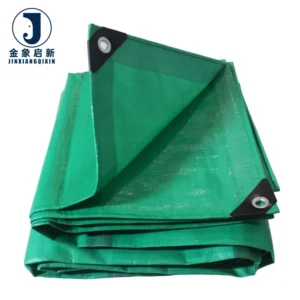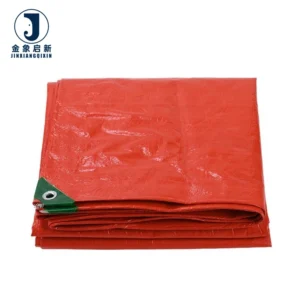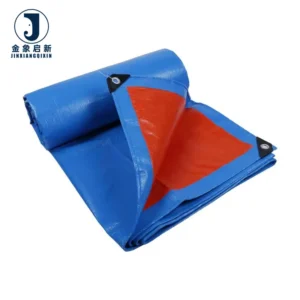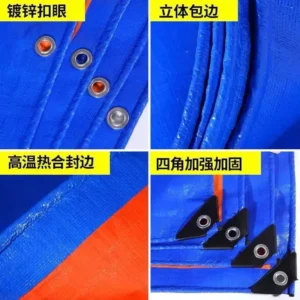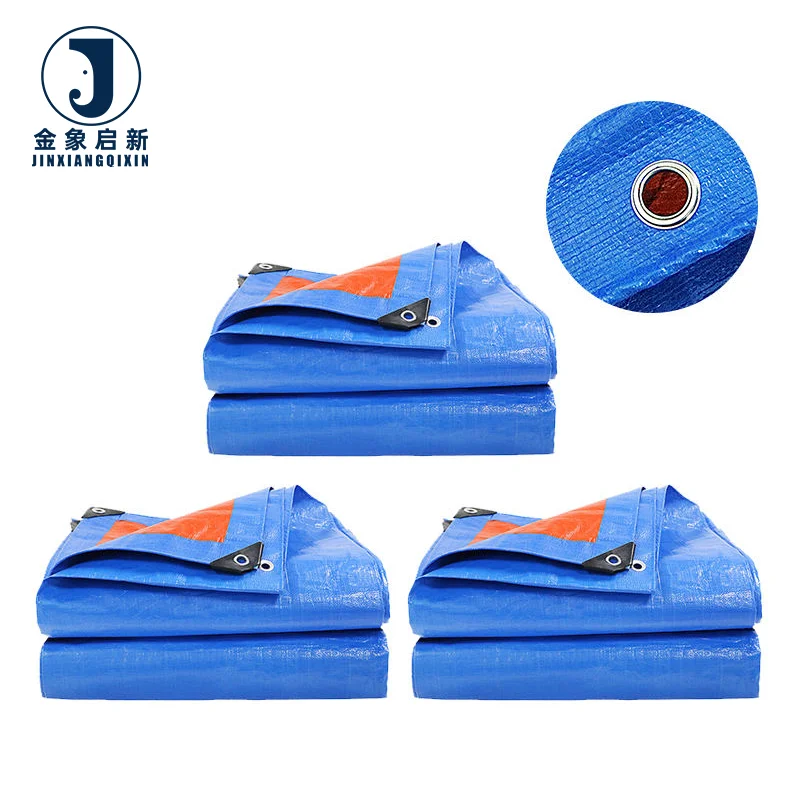
Precision-Fitted Truck Covers — Covers are cut to specific trailer model dimensions rather than generic sheets, with hem reinforcement and eyelet placement matched to each vehicle’s anchor points to eliminate gaps and flapping under highway speeds.
Technical Specifications
| Parameter | Value |
|---|---|
| Product Type | PE Tarpaulin |
| Material | HDPE weaving with LDPE lamination on both sides |
| Weight Range (Lightweight) | 80-110 g/m² |
| Weight Range (Medium) | 120-150 g/m² |
| Weight Range (Heavy-duty) | 160-240 g/m² |
| Thickness (Lightweight) | 0.18-0.22 mm |
| Thickness (Medium) | 0.22-0.28 mm |
| Thickness (Heavy-duty) | 0.30-0.35 mm |
| Knitting Density (Lightweight) | 8×8 |
| Knitting Density (Medium) | 10×10 |
| Knitting Density (Heavy-duty) | 12×12 |
| Tensile Strength (Lightweight) | Meridian 300-500 N/5cm / Latitude 250-450 N/5cm |
| Tensile Strength (Medium) | Meridian 500-800 N/5cm / Latitude 400-700 N/5cm |
| Tensile Strength (Heavy-duty) | Meridian 900-1200 N/5cm / Latitude 700-1000 N/5cm |
| Roll Width Options | 6ft, 8ft, 10ft, 12ft or 2m, 4m, 6m |
| Roll Length Options | 100 yards, 100 meters, or as per buyer’s wish |
| Finished Edge | All four edges reinforced with PP rope in hem |
| Eyelets | Galvanized eyelets every 3ft or 1 meter interval |
| Corners | Reinforced plastic corners |
| Colors | Blue, Blue/Orange, Green, Grey, Black, Clear, Grey/Green, Orange, or custom |
| UV Treatment | Available (test basis not stated in source) |
| Waterproof | Yes |
| Anti-Mildew | Mildew proof and anti-aging |
| Key Features | Waterproof, washable, tear resistant, weather proof |
Application Suitability
| Application | Exposure & Requirement |
|---|---|
| Flatbed truck load covers | Highway-speed wind load, rain ingress, road spray abrasion, UV from overhead sun |
| Curtain-side trailer replacement | Constant flexing at folds, tie-down stress at eyelets, friction against trailer frame rails |
| Agricultural transport haulage | Short-haul exposure, dust and crop residue contact, frequent untying and re-tying |
| Industrial freight covering | Heavy load shifting, long-haul weather cycling, forklift contact during loading |
Why a Generic Size Chart Fails on the Highway
PE Tarpaulin for truck and transport must be dimensioned to the trailer, not the nearest standard cut size.
Fleet operators routinely receive covers that are nominally the right size but leave gaps at corners or put tension on eyelets that were never designed to carry the load. When a cover is two inches too short on the drop, the hem rides above the trailer bed and water channels directly onto the freight. Two inches too long and the excess fabric flaps against itself at speed, wearing through the LDPE lamination in weeks rather than seasons [NEED_CITE: tensile and tear test methods for coated fabrics per ISO 1421]. The problem compounds across a mixed fleet — a 40ft flatbed and a 40ft curtain-sider need entirely different cover profiles even though the length is identical.
Model-Specific Dimensioning Eliminates Fleet Cover Gaps
This PE Tarpaulin range is cut and finished to the exact trailer model in your fleet, not pulled from a generic dimension table. The PP rope-reinforced hem runs all four edges, and galvanized eyelets are punched at 3ft or 1-meter intervals — spacing that distributes tie-down tension evenly across the hem rather than concentrating force at corner points. Reinforced plastic corners are fitted at high-stress intersections where the cover meets trailer hardware and load edges.
Matching Weight Grade to Route Exposure and Load Type
Three distinct weight tiers serve different transport conditions. Lightweight 80–110 g/m² covers handle short-haul agricultural and yard movements where the cover is on and off daily. Medium 120–150 g/m² grades suit standard warehouse and regional truck routes with moderate weather exposure. Heavy-duty 160–240 g/m² covers are built for long-haul industrial freight where road vibration, sustained wind, and weather cycling demand higher tensile reserves. Selecting the correct grade prevents both over-specification cost and under-specification failure [NEED_CITE: DIN 4102 fire classification for building materials].
Reading GSM, Knit Density, and Tensile Strength Together
Knitting density and weight must be evaluated as a system. An 8×8 mesh at 80 g/m² delivers lower tensile resistance but adequate performance for lightweight, short-haul covering where handling ease matters. A 12×12 mesh at 160–240 g/m² concentrates more HDPE yarn per square metre, raising both meridian and latitude tensile strength substantially — meridian reaching 900–1200 N/5cm. The double-side LDPE lamination seals the weave, providing waterproof protection while the knit structure carries the mechanical load. Thickness correlates with puncture resistance at load contact points: 0.30–0.35 mm on heavy-duty grades withstands forklift tine contact and load shifting that would breach the 0.18–0.22 mm lightweight construction.
The Cost of Batch Colour Drift Across a Fleet Order
When a transport company orders fifty PE covers in the same blue for fleet uniformity, colour variation between rolls becomes visible the moment covers are installed side by side on parked trailers. This is not a cosmetic issue alone — inconsistent colour across rolls in a single shipment often signals variation in LDPE lamination thickness and UV additive distribution. Covers from a poorly controlled batch may age at different rates, with some fading and becoming brittle while adjacent covers remain intact [NEED_CITE: ISO and CE standards for coated fabric quality control]. Fleet operators then face staggered replacement cycles instead of a single planned changeover.
Why Transport Fleets Source From This Line
Production runs across three full lines with 36 sets of equipment, supporting bulk PE tarpaulin orders for mixed-vehicle fleets without sacrificing delivery schedules. A 10-person R&D team handles model-specific dimensioning, custom colour matching, and sample development before bulk commitment. Dedicated QA/QC runs at every stage — GSM is verified against the quotation at dispatch, not assumed from the production order. Eyelet pull-out and hem reinforcement integrity are tested at flex points before covers are cleared for shipment. Samples for custom sizes and colours are developed within days, allowing fleet operators to confirm fit and finish before placing the full order.
Documentation & Verification
- GSM weight verification per roll against the quoted specification before dispatch
- Pre-shipment inspection record confirming eyelet spacing, hem integrity, and corner reinforcement
- Colour consistency check documented across all rolls and finished sheets in the order
- ISO and CE certificates supplied with shipment for fleet compliance records
- Certificate of origin and roll packing list for customs clearance
Fabrication, Handling & Storage
- PP rope hem and galvanized eyelet spacing must match trailer anchor point layout for load distribution
- Reinforced plastic corners protect high-wear zones where cover meets trailer frame hardware
- Store rolled PE tarpaulin upright to prevent permanent crease marks across the LDPE lamination
- Avoid dragging heavy-duty 160–240 g/m² covers over rough ground to prevent LDPE surface abrasion
- Clean with mild detergent only — solvents degrade the LDPE lamination bond to the HDPE weave
Specifying Your PE Tarpaulin for Transport
Provide your trailer make, model, and year along with the exact cover dimensions or deck measurements so the cut can be matched to the vehicle rather than a standard size. Indicate the primary route climate and average exposure conditions so the correct GSM grade and UV treatment level can be confirmed. For fleet orders, specify the number of vehicles, colour requirements, and whether you need finished covers with eyelets or roll stock for in-house fabrication.
Frequently Asked Questions
Q: How do I confirm the GSM on arrival matches what was quoted?
A: Each roll and finished cover is weighed and measured during pre-shipment inspection, with the result recorded against the quoted GSM grade. You receive this inspection record with your shipment documentation. If any discrepancy is found at your receiving dock, the documented pre-shipment weight provides a baseline for resolution.
Q: Can covers be cut to my specific trailer model dimensions?
A: Yes. Provide the trailer make, model, and exact deck or curtain measurements. Covers are then cut and hemmed to those dimensions with eyelets positioned to match your trailer’s anchor points, rather than supplied in a generic standard size that leaves gaps or excess fabric.
Q: How is eyelet spacing determined for high-wind highway conditions?
A: Galvanized eyelets are set at 3ft or 1-meter intervals along the PP rope-reinforced hem. This spacing distributes tie-down tension evenly and prevents concentrated pull at individual points. For routes with sustained high wind, heavier gauge tie-down cord and closer eyelet intervals can be specified during the order.
Q: How is colour consistency maintained across a bulk fleet order?
A: All rolls for a single order are produced in the same batch run, with colour checked across the production sequence. A batch consistency record accompanies the shipment, documenting that every cover in the order falls within the same colour tolerance range.
Q: What documentation comes with a transport fleet shipment?
A: You receive a material specification sheet confirming GSM and material construction, a pre-shipment inspection record, roll packing list, ISO and CE certificates, and a certificate of origin. This package supports fleet compliance audits and customs clearance in your destination market.