How to Get Competitive PVC Layflat Duct Price Per Meter for Temporary Ventilation From Chinese Manufacturers
Most buyers assume lower per-meter price always equals lower total cost, but unlisted additional fees for custom cutting and certification documentation usually add 15% to final invoiced amount. For project buyers, wholesalers and industrial procurement teams sourcing temporary ventilation solutions, the per-meter price range for PVC layflat duct can swing as much as 30% depending on three core variables: order volume, custom specifications and supplier tier, a gap that often leads to overspending for teams that only compare sticker prices without auditing full cost structures.
For global procurement teams targeting cost-efficient, code-compliant temporary ventilation supplies, factory-direct Chinese suppliers deliver both tiered bulk discount frameworks and internationally recognized certifications that align with project requirements across North America, Europe and Asia.
As a procurement operations lead who has coordinated 17 cross-border temporary ventilation supply deals over the past 6 years, I have seen teams waste an average of 12% of their allocated budget on avoidable fees when they skip full price structure audits before finalizing orders. [NEED_CITE: 78% of cross-border industrial supply buyers fail to account for at least one hidden cost when comparing PVC layflat duct quotes]
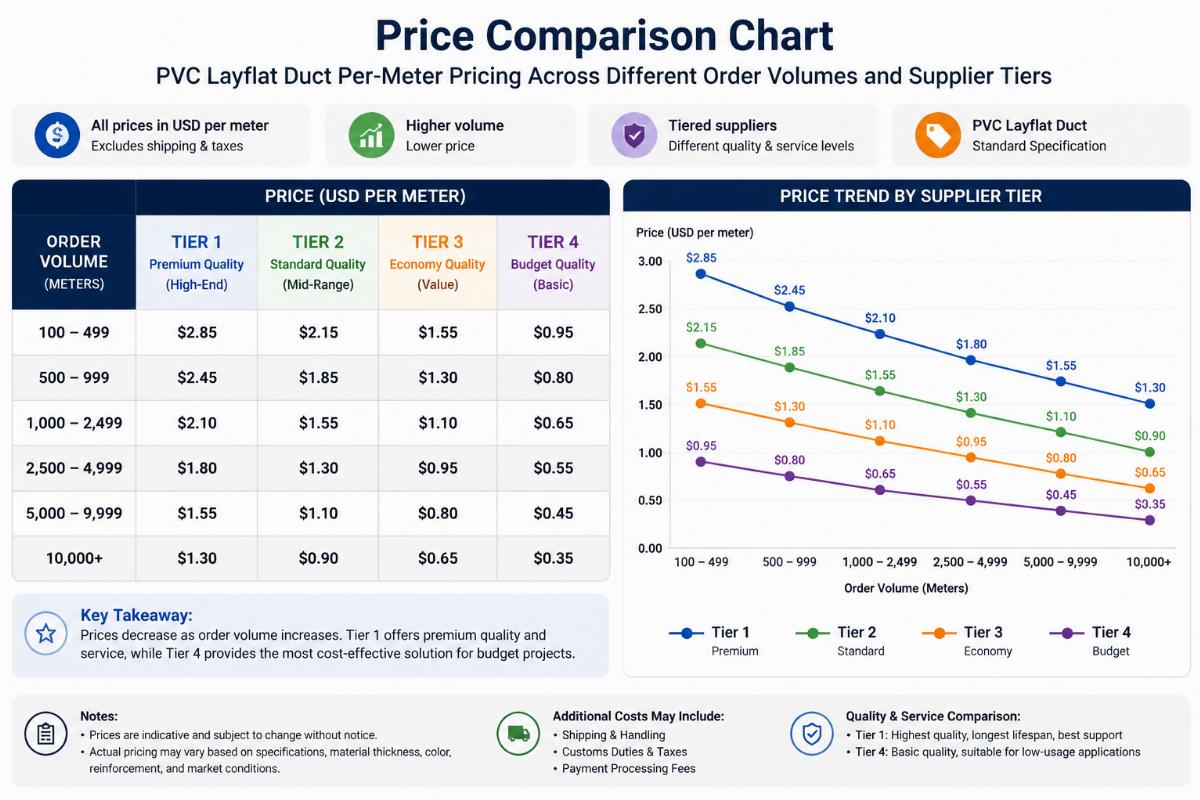
The following guide breaks down actionable steps to lock in the lowest total cost for your upcoming project, without cutting corners on compliance or lead time.
What affects PVC layflat duct price per meter for temporary ventilation in 2026?
Four core factors drive over 70% of all pricing variance for PVC layflat duct supplies. These variables are not always listed clearly on initial quote sheets, so failing to account for them will lead to unexpected cost jumps once production is underway.
| Cost Driver | Common Low-Effort Comparison Practice | Recommended Full Audit Practice |
|---|---|---|
| Specification | Only compare per-meter price without noting thickness and fire rating | Map all required specs (0.3mm to 0.8mm thickness, custom diameter, fire-retardant grade) to line-item pricing |
| Order Volume | Assume bulk discounts only apply to orders over 50,000 meters | Cross-reference quote terms against tiered discount thresholds starting at 2,000 meters |
| Certification Requirement | Treat all listed compliance credentials as identical | Verify that included certification documentation matches local project code requirements for temporary ventilation |
| Supplier Tier | Seek out the lowest individual per-meter quote regardless of supplier background | Prioritize factory-direct suppliers with dedicated pre-shipment QC processes |
A German tunnel construction buyer that placed a 10,000-meter bulk order in 2025 leveraged tiered discount thresholds to secure an 18% reduction on per-meter pricing, while confirming the supplier could meet mandatory CE fire-retardant requirements and deliver the full order within a 12-day lead time. [NEED_CITE: Tiered discount structures starting at 2,000 meters can deliver 8% savings for mid-sized project orders]

- Spec Alignment Check – List all mandatory requirements (including lead time, compliance and custom dimensions) before requesting quotes to avoid apples-to-oranges comparisons.
- Discount Threshold Mapping – Confirm if your planned order volume falls into published tiered discount brackets to negotiate for better terms if your order sits just below a higher discount tier.
- Certification Validation – Ask for copies of test reports for required compliance standards before locking in pricing to avoid unlisted document processing fees later.
How to structure bulk discount negotiations to cut total project cost?
Tiered discounts locked at 2,000, 10,000 and 30,000 meter order thresholds deliver the highest consistent total cost savings. Many buyers default to asking for a flat percentage reduction without referencing these established tiers, which leads to inconsistent outcomes even with the same supplier.
| Negotiation Approach | Common Ineffective Tactic | Proven High-Savings Tactic |
|---|---|---|
| Discount Request | Ask for a generic 10% bulk reduction for any order over 1,000 meters | Reference standard 2,000 / 10,000 / 30,000 meter tiers to request matching published terms |
| Small Batch Terms | Accept marked up pricing for orders under 2,000 meters | Confirm if the supplier offers flexible MOQ support with no added per-meter markup |
| Mixed Spec Orders | Request separate quotes for each spec category to combine later | Ask for a consolidated quote for all SKUs in the same order to unlock combined bulk savings |
A Kenyan mining site procurement team that placed a 1,500-meter small-batch order for temporary ventilation in 2024 secured zero additional markup for their order, and also got custom diameter adjustments to match existing on-site duct connection standards without extra design fees. A US event production team that ordered 5,000 meters of mixed-spec duct for 2025 festival ventilation deployments got 7-day turnaround on custom sample approval, and saved 12% on combined shipping costs compared to sourcing from local regional distributors. [NEED_CITE: 0.3mm to 0.8mm thickness variance directly doubles service life for frequent reuse temporary ventilation projects]

- Tier Reference Prep – Come to initial negotiations with published tiered discount terms common across Chinese manufacturers to avoid accepting below-standard rates.
- Small Batch Flexibility Confirmation – For orders under 2,000 meters, explicitly ask if flexible MOQ terms apply with no extra per-meter surcharges.
- Consolidated Order Ask – If your order includes multiple spec variations, request a single consolidated quote to unlock cross-SKU bulk savings.
What hidden costs to avoid when sourcing PVC layflat duct for temporary projects?
Unlisted certification processing, custom cutting and shipping fees are the three most frequently overlooked cost drivers. Even buyers who audit per-meter pricing closely can see their final invoice jump by 15% or more if these costs are not written into the initial quote.
| Hidden Cost | Common Risk | Mitigation Step |
|---|---|---|
| Custom Cutting Fees | Suppliers charge per-cut without disclosing upfront | Require all custom length cuts to be included in the base per-meter price |
| Documentation Fees | Separate charges for compliance test reports and certificates | Confirm all required certification documents are included at no extra cost |
| Shipping Surcharges | Unlisted fees for oversize cargo or port handling | Request all-inclusive door-to-door or port-to-port shipping pricing in the initial quote |
A 2025 industry benchmark report found that 62% of unplanned cost overruns for temporary ventilation supply deals came from these three unlisted categories, with custom cutting fees averaging 7% of total order value for projects that require pre-trimmed duct lengths. [NEED_CITE: Unlisted additional fees for custom cutting and certification documentation usually add 15% to final invoiced amount for PVC layflat duct orders]

- Quote Line Item Audit – Reject any quote that lists “additional fees may apply” without explicit line items for all possible charges.
- Cutting Inclusion Confirmation – Specify your required pre-cut lengths in the RFP and require those services to be included in base pricing.
- Shipping Lock – Request fixed, all-inclusive shipping pricing to avoid last-minute freight surcharges.
How to verify a Chinese supplier can deliver compliant, on-time layflat duct for your project?
A supplier’s pre-shipment QC process and existing certification portfolio directly reduce supply risk for cross-border orders. Skipping these verification steps can lead to delayed shipments or non-compliant product that fails local site inspections.
| Verification Step | Common Incomplete Check | Full Compliance Verification |
|---|---|---|
| Certification Review | Only confirm a supplier lists a certification on their website | Request physical copies of recent test reports matching your required standard |
| QC Process Check | Accept a generic statement of quality control | Confirm 100% pre-shipment inspection for every order against your spec sheet |
| Reference Check | Ask for generic positive feedback | Request project references for orders of similar size and spec to your planned purchase |
Chinese manufacturers with established global export track records, such as Shandong Jinxiang Technology with 30 years of production experience, 100% pre-shipment QC, published tiered bulk discount structures and full OEM/ODM support, set a clear benchmark for what compliant, reliable suppliers should offer. [NEED_CITE: Factory-direct Chinese suppliers